


Important Topics for Legal Reasoning - CLAT 2027

Updated: May 21
To kill it in legal section of CLAT, you need 3 things –
1. Knowledge about basic laws
2. Awareness about latest legal happenings in India and the world (Legal GK), and finally,
3. Lots of practice
I will write an article about Legal GK soon, and I have already made a lot of videos around solving legal questions. In this article I give you important topics you should study for Legal section.
Constitutional Law:
What is constitution
What is preamble
What are fundamental rights - From Article 12 to Article 32
Directive Principles of State Policy
Judicial bodies - Supreme court, High Court, District courts
Quasi-Judicial bodies – Tribunals
Writs, Rights and duties
Elections to President, Vice-President, legislative assembly, etc
Important acts like Panchayati Raj, Emergency powers, etc
Important Constitutional Amendments (Legal GK)
Law of Contracts -
Nature of contracts and formation - Offer, acceptance, consideration, agreement, etc
Meaning of void, valid, voidable, contracts
Competent parties, free consent, mistake, doctrine of contracts
Quasi-contracts
Discharge of contracts
Guarantee, indemnity, insurance
Consequences of breach of contracts
Special form of contracts such as Agency, Partnership, Contingent contracts, bailment, pledge, hypothecation, mortgage, etc
Torts –
Definitions - what is meant by Torts
3 maxims - Injuria Sine Damnum, Damnum Sine Injuria, Ubi Jus ebi remedium
Difference b/w torts and crime + torts and contracts
Concept of Reasonability
Liability, strict and absolute liability, different types of liability
Joint tortfeasors
General Defences
Remedies
Negligence
Defamation
Conspiracy
Assault, Battery
False imprisonment and malicious prosecution
Source of studying Consti, Contracts and Torts - https://www.icsi.edu/media/webmodules/CSEET/LEGAL_APTITUDE_AND_LOGICAL_REASONING_printable.pdf
Criminal Law -
In criminal law, there are multiple topics you need to study -
General Principles of Criminal Law (these are general concepts you need to understand before proceeding ahead)
Definition and elements of crime
Essential elements: actus reus (guilty act) and mens rea (guilty mind)
Stages of crime: intention, preparation, attempt, and commission
Presumptions of innocence and burden of proof
Indian Penal Code -
Structure and basic provisions of IPC
Offenses against the human body (e.g., homicide, assault, and hurt)
Offenses against property (e.g., theft, robbery, extortion)
Offenses against women (e.g., rape, dowry death, domestic violence)
Defamation (Section 499 and 500)
Criminal conspiracy (Section 120A and 120B)
Criminal Procedure Code -
FIR (First Information Report) – the basics
Bail – the basics
Compounding of offenses and plea bargaining – meaning
Basics of other criminal laws –
Juvenile Justice Act
Prevention Of Corruption Act
Narcotic Drugs and Psychotropic Substances (NDPS) Act
Domestic Violence Act
Protection of Children from Sexual Offenses (POCSO) Act
Intellectual Property Law:
Concepts of Trademarks,
Patents,
Copyrights, and
other IP-related laws.
Current Legal GK on IP Laws
Civil Law:
Questions on Code of Civil Procedure,
Property Law
Alternate dispute resolution
Basics of Family Law:
Knowledge about Personal laws such as Hindu Marriage Act, Muslim Laws, etc
Legal GK based on these laws
International law –
This is a topic where you need to just have basic understanding
Major international bodies like the UN, WTO, IMF, World Bank etc
Knowledge of few case laws such as – Dalai Lama Asylum case, SS Lotus case. These are not required but in case you have time you can study. Would take few minutes only.
International treaties
Sources of international law – the basics
Law of the sea – the basics
State recognition
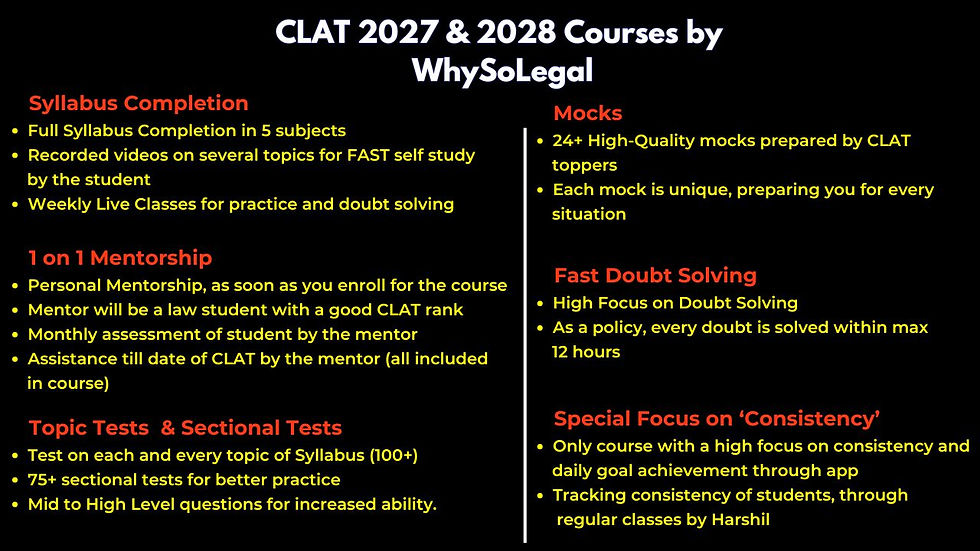
I will keep on updating this list. At last, if you are preparing for CLAT 2027 & 2028, you can check out my CLAT courses.
This course contains all you require in all 5 subjects, along with mocks, sectional tests, daily materials, notes and much more!
We have practice sessions every week, where my team of experts solve questions in all 5 subjects with you!
We got great results in our first ever batch for CLAT 2025 - AIR 641, AIR 678, AIR 701.
I suggest checking out the course here - https://learn.whysolegal.com/store


https://soicauxsmb.com/ hôm trước thấy bạn bè nhắc nhiều quá nên mình cũng bấm vào xem thử cho biết. Mình không đọc sâu đâu, chủ yếu lướt nhanh xem họ làm giao diện kiểu gì. Ấn tượng đầu là trang nhìn khá sáng sủa, khoảng trắng vừa đủ nên kéo xuống không bị rối mắt. Mình để ý mấy phần dữ liệu họ trình bày theo dạng bảng/cột nên nhìn cái là hiểu đại khái ngay, đỡ phải soi từng dòng. Thanh menu cũng để chỗ dễ thấy, bấm qua lại vài mục cơ bản khá mượt, không phải tìm vòng vòng. Nói chung kiểu sắp xếp theo khối rõ ràng, các bảng số liệu hiện ngay trên trang nhìn gọn…
https://siempreeslunes.com/ hôm trước mình thấy người ta bàn tán nên bấm vào xem thử cho biết. Mình không có ngồi chơi gì hết, chỉ lướt qua kiểu xem trang họ trình bày ra sao thôi. Cảm giác đầu tiên là nội dung được chia thành mấy khối khá rõ ràng, nhìn cái là biết phần giới thiệu nền tảng nằm đâu, phần nổi bật nằm đâu, không bị rối mắt. Có đoạn nhắc đến hệ sinh thái trò chơi phong phú với trải nghiệm hiện đại, đọc lướt cũng nắm được ý chính. Mình mở bằng điện thoại thì tiêu đề vẫn gọn, không bị lệch hay phải phóng to thu nhỏ liên tục. Nói chung nhìn khá “sạch” vì…
https://soicau247.com/soi-cau-366-mb.html mình lướt thấy bạn bè nhắc nên bấm vào xem cho biết chứ không có ý ngồi soi sâu gì đâu. Vào cái là thấy họ chia nội dung theo kiểu từng khối rõ ràng, có mục lục ở trên nên kéo xuống là biết mình đang đọc phần nào, không bị lạc. Mình để ý đoạn họ cho xem lại kết quả kỳ trước đặt khá dễ nhìn, kiểu muốn đối nhanh thì tiện. Chữ không bị dày đặc, khoảng trắng vừa đủ nên đọc đỡ mỏi mắt. Mấy bảng số liệu trình bày theo cột gọn, nhìn phát là hiểu, không phải căng mắt dò từng dòng. Nói chung trải nghiệm lướt nhanh ổn, nhất là cách…
keonhacai tv bữa mình lướt thấy trong group nhắc nên tò mò vào xem thử cho biết thôi. Vừa vào cái là thấy giao diện khá gọn, kiểu ưu tiên luôn phần bảng kèo nên không phải tìm nhiều. Mình để ý họ trình bày theo dạng bảng nhìn dễ theo dõi, có cột giờ trận đấu với phần cả trận hiệp 1 tách ra rõ ràng nên liếc nhanh cũng nắm được. Kéo xuống dưới còn có mấy đoạn giải thích “kèo nhà cái là gì” viết ngắn gọn, đọc vài phút là hiểu cơ bản, hợp ai mới xem kèo mà không muốn đọc dài dòng. Nói chung mình chỉ xem qua chứ không đào sâu, nhưng cách…